

I’ve spent the last week bingeing Grand Theft Auto VI content, absorbing the story through my phone by reading text messages on in-game phones, by scrolling on social media through screenshots of in-game social media posts, some of which are themselves in-game screenshots.
PC gamers like me are consigned to pressing our faces against the shop windows of culture while console havers feast on the biggest media release ever. Not the biggest game launch. The largest debut for any piece of media in history, raking in $3.79 billion in day-one retail sales and accounting for nearly a quarter of all internet traffic within Comcast’s network at one point. It generated more money in 24 hours than the projected GDP of about two dozen countries this year.
The Rockstar team’s success shows video games are cornerstones of a new monoculture. Shared experience isn’t dying; it’s changing. For better or worse. And in the case of GTA VI, I would go further and say it revives an old ideal: the Great American Novel.

I’m not suggesting video games could or should replace literature, or that the former is in any way superior to the latter. They’re not. I’m simply noting that a convergence between the two is possible. In fact, it’s already happened. See Dungeon Crawler Carl, the most prominent work of litRPG, where the narrative relies on the rules and mechanics of virtual role-playing games. Author Matt Dinniman serialized it online and found such an enormous readership that Penguin Random House acquired the rights. It’s very popular, but not something for me. I thumbed through a copy once at Walmart. Ten minutes with Carl up the aisle from Funko Pops made me yearn for Adderall.
Novels have become more like games; games have become more like novels, and GTA VI is a contender for a 21st-century Great American Novel—a national epic that contains the multitudes of a strange country.


The concept of the Great American Novel, or GAN, originated with John William De Forest, a Civil War officer and writer. In an essay for The Nation, he declared our democracy still too young for “the Great American Poem.” However, though it was too early for an Aeneid, it was not too soon for a “tableau” of the American soul—“a picture of American life, drawn with a few strong and passionate strokes, not filled in thoroughly, but still a portrait.” De Forest felt that only Uncle Tom’s Cabin approached his ideal. Not because it was perfect in every way. Indeed, he wrote that it had “a very faulty plot” and gently criticized Harriet Beecher Stowe on a few other counts. But literary perfection wasn’t the measure of greatness he had in mind. It was the “national breadth to the picture, truthful outlining of character, natural speaking, and plenty of strong feeling” that made it the Great American Novel of his day.
That was in 1868, when America contained fewer people than live in California today.
The ideal has always been elusive. A white whale, as it were, from the start. That the meaning of that phrase is readily understood attests both to the place of Herman Melville’s Moby-Dick on the GAN list and to the resonance these works have in the public mind. Yet within three decades of Moby-Dick’s publication, the GAN had already become “as chimerical as the Great American Poem,” wrote literary critic Elaine Showalter in a review of Lawrence Buell’s The Dream of the Great American Novel.
The GAN’s stock waxed and waned through the 20th century and by the 21st was declared obsolete, according to Showalter. She suggests that nostalgia “for the GAN resembles nostalgia for the days before multi-channel TV, when everyone watched the same sitcom or drama.” She ties its passing to the reality that “longhonoured assumptions about the national consciousness and its fictional heroes and representatives can’t stand up in the era of sharply divided Red and Blue states.”
Buell is less decisive. He believes the GAN may be “headed for permanent eclipse,” or “it may be endlessly reinvented and kept alive.”
It’s remarkable how discussions about the GAN resemble debates over what GTA VI signifies, whether this moment marks, as I believe, a new phase of the monoculture or the end of it in a society that seems too fragmented, too vast for there to be sufficient “cultural glue,” as Buell puts it, with which to paste the pieces into a nationally coherent fiction. Yet his reading of Moby-Dick and the whaling ship Pequod as representing “the state and fate of democratic society, American style, as it appears in the era of early industrial capitalism” is essentially how I see GTA VI’s accomplishment in our era of late industrial capitalism.
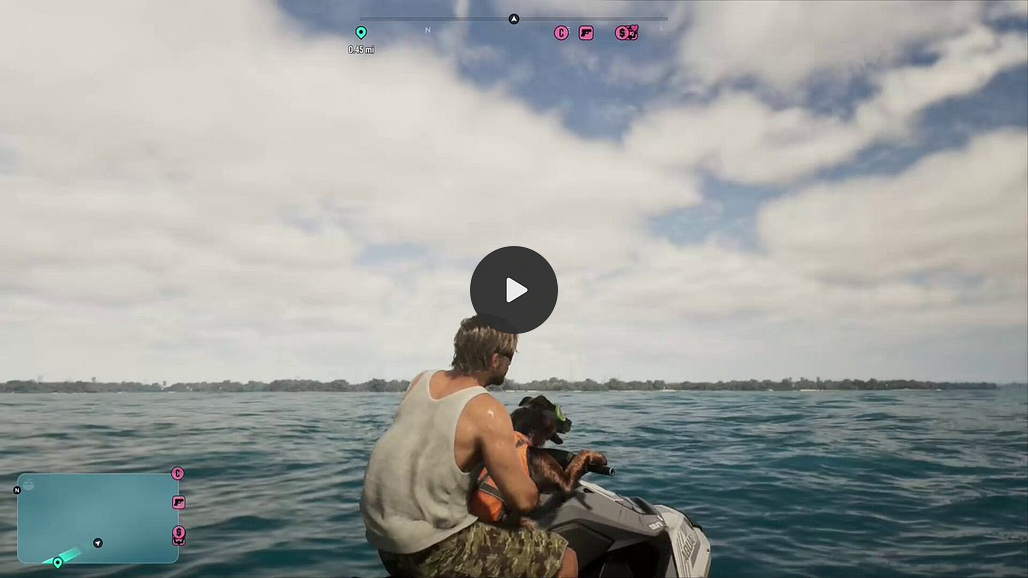
GTA VI is set in the fictional state of Leonida, modeled on Florida, and the real Florida often seems like someone’s fever dream of America. Leonida is home to NPCs suspicious that they are trapped in a simulation. People stranded in the waters off its shores will eventually be rescued by a dog on a jet ski wearing goggles and a life jacket. As it turns out, Rockstar didn’t need to do much imagining: there is a real dog in Florida named Loosy who cruises around the Keys on a jet ski.

Florida is America distilled. Perhaps no other state folds within itself such jarring cultural, linguistic, political, and economic diversity. It has the Deep South to the north and Northeast influence to the southeast, distinct Caribbean outposts in Miami and the Keys, a transplant-heavy hub in the center that can resemble a Breezewood with palm trees, farmworkers tending crops in Immokalee to the southwest and in the rich dark soil of the Glades, and the cracker cowboys pushing cattle around Lake Okeechobee. Tech, finance, and luxury live next door to abject poverty and roller coasters. Jewish communities defy vile neo-Nazi trolls while Muslims pray up the road from Christian nationalists in a state Spanish Catholics seeded on Timucua land right before massacring French Protestants near the spot that would one day be the location of the first legally sanctioned free black settlement in the not-yet-born United States, founded by self-emancipated Africans who mingled with the people known today as the Seminoles, themselves refugees. Florida is home to the launch site of the first manned moon landing and the top-ranked conspiracy theorist hot spot, where English turns to Creole and bleeds into Spanish and Spanglish and then Miami English, a place at once ultra-right-wing and supremely hedonic, redneck and cosmopolitan, over-the-top patriotic and one of the least patriotic in practice, where bacchanalia meets button-down Republican politicos who lead shockingly depraved private lives, and you can find vaudeville and vodou in the same ZIP code. “Florida is the most Goth State,” as one poster put it. “Because it is where Goths suffer the most.”

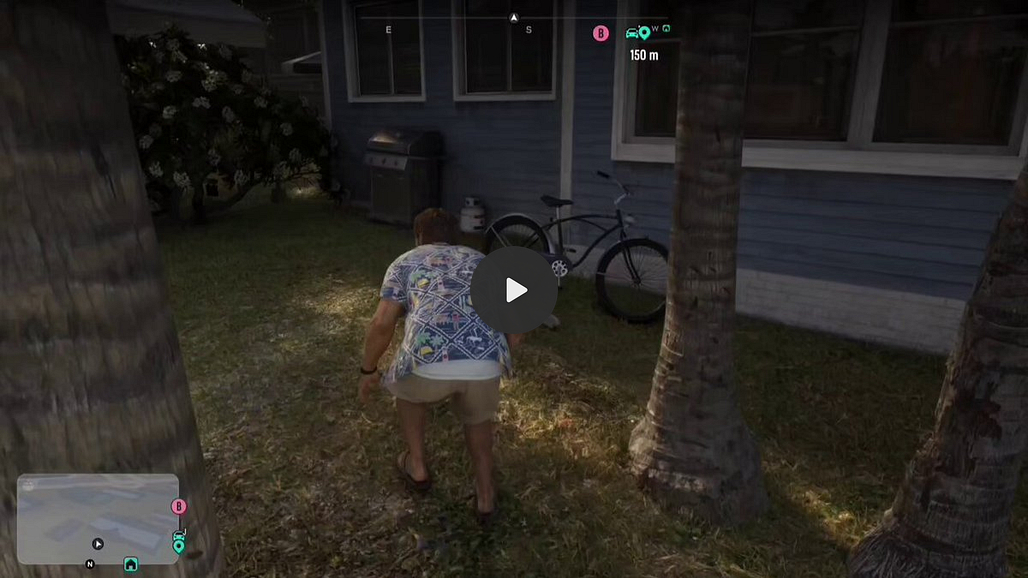
America is Florida, Florida is America, and America is as much a psychic terrain as a geographical territory. Rockstar captures both with its fidelity to the actually existing region and our interior lives littered with memes, pop culture references, urban legends, and internet lore spanning generations. All this is rendered as aspects of the game itself—as side quests, NPC dialogue, and so on—or fed to players through Snapmatic, an in-game social media app that invites you to virtually doomscroll in between doomscrolling while gaming.


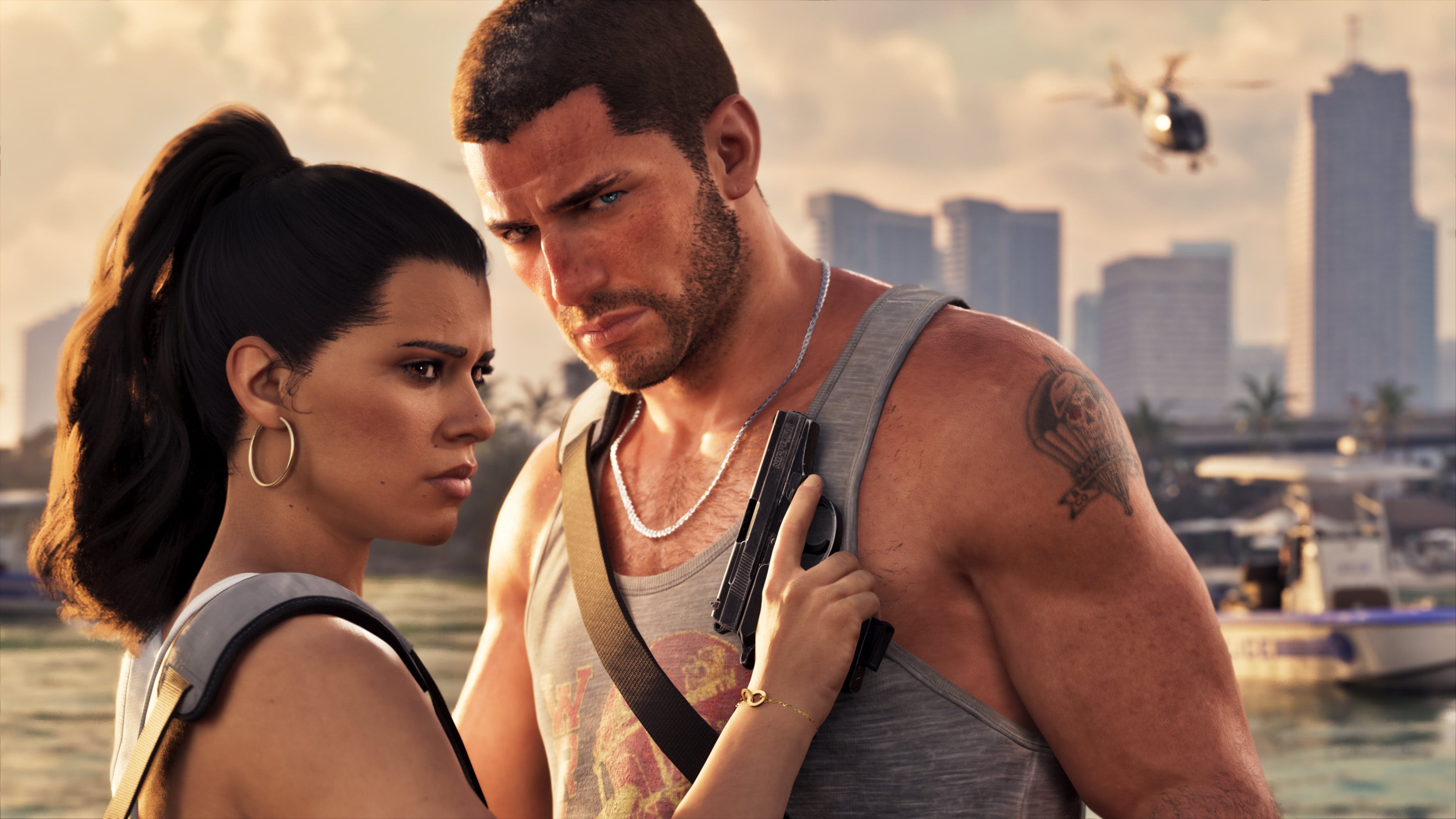
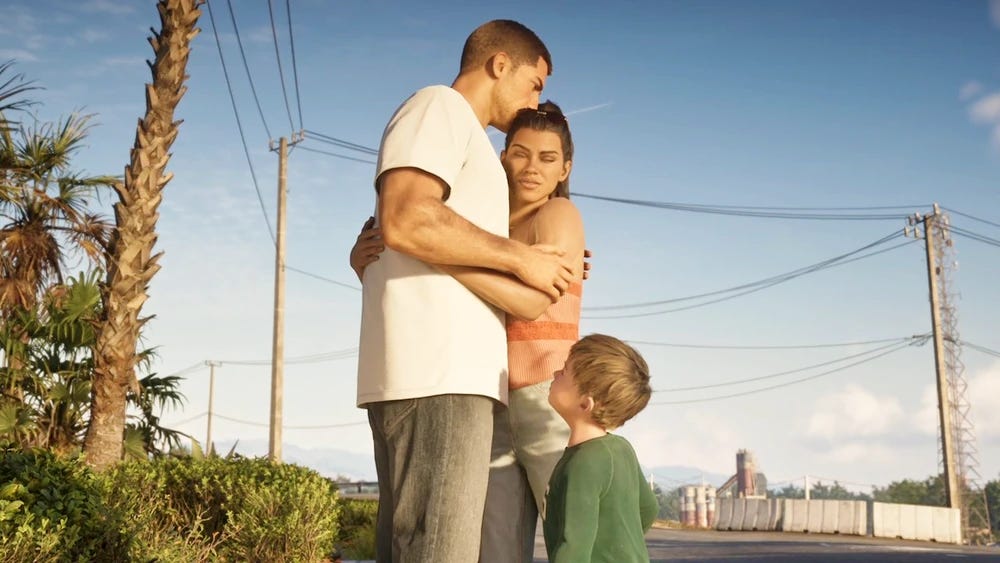
The narrative thread is the intertwined fates of Jason Duval and Lucia Caminos, a modern Bonnie-and-Clyde couple. Their relationship heavily influences the story’s outcome. Rockstar’s decision to make their romance integral to the game triggered seething among chuds. These are a unique species of right-wingers whose primary vector for interacting with politics is media—movies, video games, music, books. Misogynistic streamers such as Zack Hoyt, aka Asmongold, serve as standard-bearers for their endless crusades of outrage at all things “woke.” Now their complaint is that Rockstar created a Latina girlfriend simulator, wherein men are rewarded for respecting and, indeed, liking women.

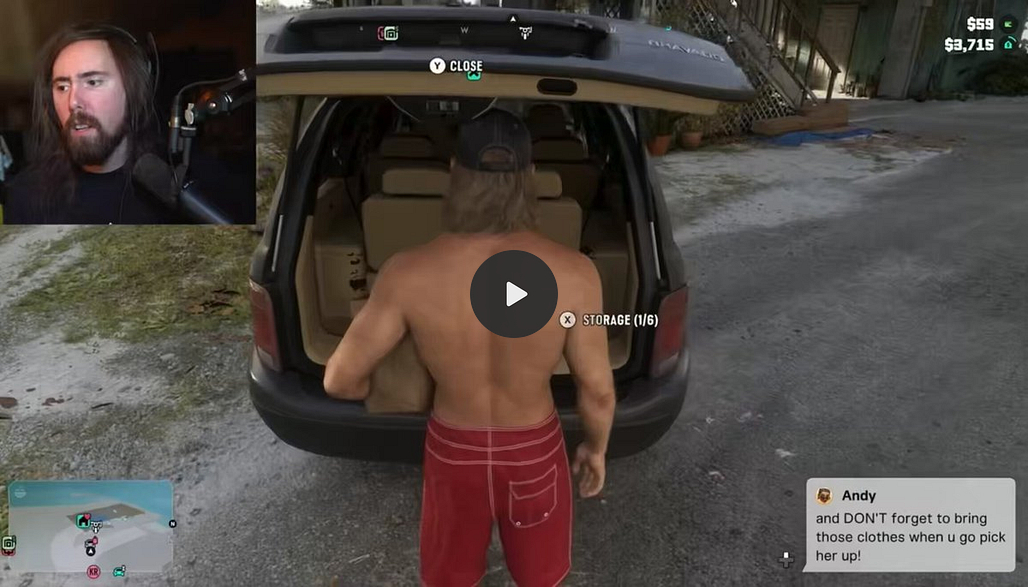
It’s appropriate that a game that encapsulates so much American culture becomes an active participant in the culture wars that define it. Asmongold, like so many chuds, is a product of GamerGate—a harassment campaign launched in 2014 by online reactionaries against perceived progressivism in the video game industry. Women were its main targets, and it set the stage for future campaigns with expanded scopes. In The New York Times, Charlie Warzel wrote that “Gamergate is occasionally framed as a battle for the soul of the internet between a diverse, progressive set and an angry collection of white males who feel displaced. And it is that, too. But its most powerful legacy is as proof of concept of how to wage a post-truth information war.”
For a while, chuds gloated that Donald Trump’s rise and GamerGate were inextricably connected, and saw in his political victory their triumph in the culture. It is fitting, if that is the case, that his political collapse occurs at the same time that the most successful entertainment launch of all time is a game that represents a cultural repudiation of their views on sex and race.

A group obsessed with hypermasculinity, convinced of the superiority of “traditional” patterns of life that they neither understand nor uphold, adhering to theories of racial supremacy with a preference for nationalist politics, finds themselves melting down at having to interact with virtual women as an affectionate man in a game they can’t stop playing that was developed by a diverse, international team. In provoking their reaction (and so many others, positive and negative), GTA VI serves another function associated with the GAN: holding up a mirror to the nation and casting its absurdities in a clear light.
GTA VI’s story does this as well by subverting expectations about why the protagonists do what they do. An intensely punitive criminal justice system contributes to Lucia’s return to a life of crime, a detail disclosed in text messages with an uncaring parole officer.


It’s an all-too-real exchange that illustrates with striking lucidity the realities that do in fact contribute to recidivism and that the average person would miss while scrolling on their virtual or physical phones.
GTA VI features a crime story with a remarkably plausible motive. Lucia is a single mother who robbed a payday loan store out of desperation; Jason, the father of Lucia’s son Tomás, is a veteran with a troubled past who left the military on bad terms and was disqualified from “loans, anything” as a result. Jason and Lucia are portraits of people in extremis chasing the American dream at a time when its existence is very much in doubt—in Leonida and the nation it attempts to simulate.
A recent CNBC survey found that just over half of respondents said the American dream is now out of reach for most of us. Maybe you’d think that for a lot of people it’s being your own boss—having Fuck You money so nobody can tell you what to do. It’s not. The top response: achieving financial stability. Seventy-two percent said their dream is being financially stable. It’s being able to breathe. To feel like you’re not drowning.
The second most dreamed-of thing is owning a home.
The third is being happy.

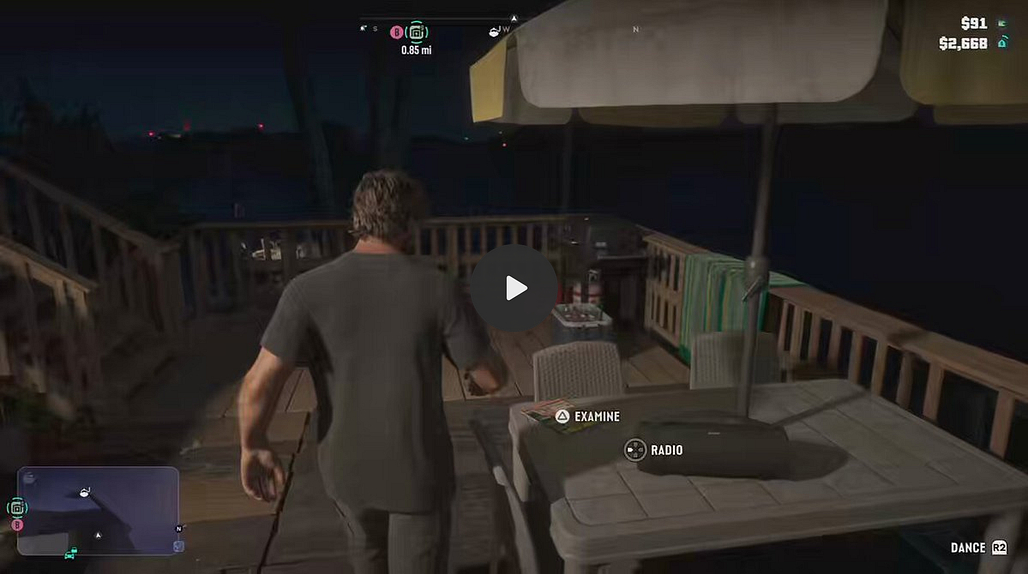
Some people have complained that GTA VI abandoned the satire of previous installments. That’s not really true. Rockstar has been playing with American dream disillusionment for a while. It has also been trending toward more grounded crime stories, with satire running alongside. GTA: San Andreas follows CJ’s quest to find his mother’s killer and fight to protect his neighborhood from rival gangs and crooked cops. GTA IV’s Niko Bellic is an immigrant searching for the American dream and revenge. The Ballad of Gay Tony centers on a Dominican American man raised by a single mother and pushed into a criminal lifestyle by poverty and circumstance. The three protagonists in GTA V are all the products of broken homes. GTA VI isn’t a rupture in the series. It’s where Rockstar has been heading. It grew up, and so did the audience. The most appealing fantasy is a happy ending in America.
What sets GTA VI apart is its scope and ambition. These previous installments were wild snapshots of familiar pieces of the American story. GTA VI seems like an earnest attempt at depicting the bigger picture. That’s why it’s the GAN in 2026. Rockstar “reinvented and kept alive” the concept with a story about America, in all its weird multitudes, rendered as it could only be when the virtual and real blur together. It’s beautifully absurd. So is this country.
If you enjoyed reading this essay, pick up a subscription today to support me. I’m publishing another article Friday.