


I’ve got a few recent interviews and articles that I’m proud of publishing, along with some updates about this newsletter. If you read this, you’ll probably see where I’m going before I get there.
First, I wrote for Washington Monthly about artificial intelligence and how models are trained on massive amounts of physical texts that are then destroyed. As usual, when the news of this got out, AI accelerationists dismissed the ensuing backlash as little more than rustic grunting. It is somewhat amusing that the people who have been telling us for years about how AI would result in mass unemployment and an end to art as we know it also live in a perpetual state of astonishment at just how much everyone seems not to care for them. As I wrote in the piece:
Those who wave away the outcry as the stuff of book-obsessives risk missing the essential point Reisner is getting at, one that goes beyond books. It’s the same reason people don’t like the vision of a future in which every American lives under the watchful eye of an AI-powered surveillance network, such as the notions promoted by Garrett Langley, the founder and CEO of Flock, an Atlanta-based technology company whose wares include automated license plate readers. It is the same reason people in Ohio, where I live, protested against a proposal by the Ohio Environmental Protection Agency to make it easier for data centers to dump wastewater into lakes, rivers, and streams without consequence.
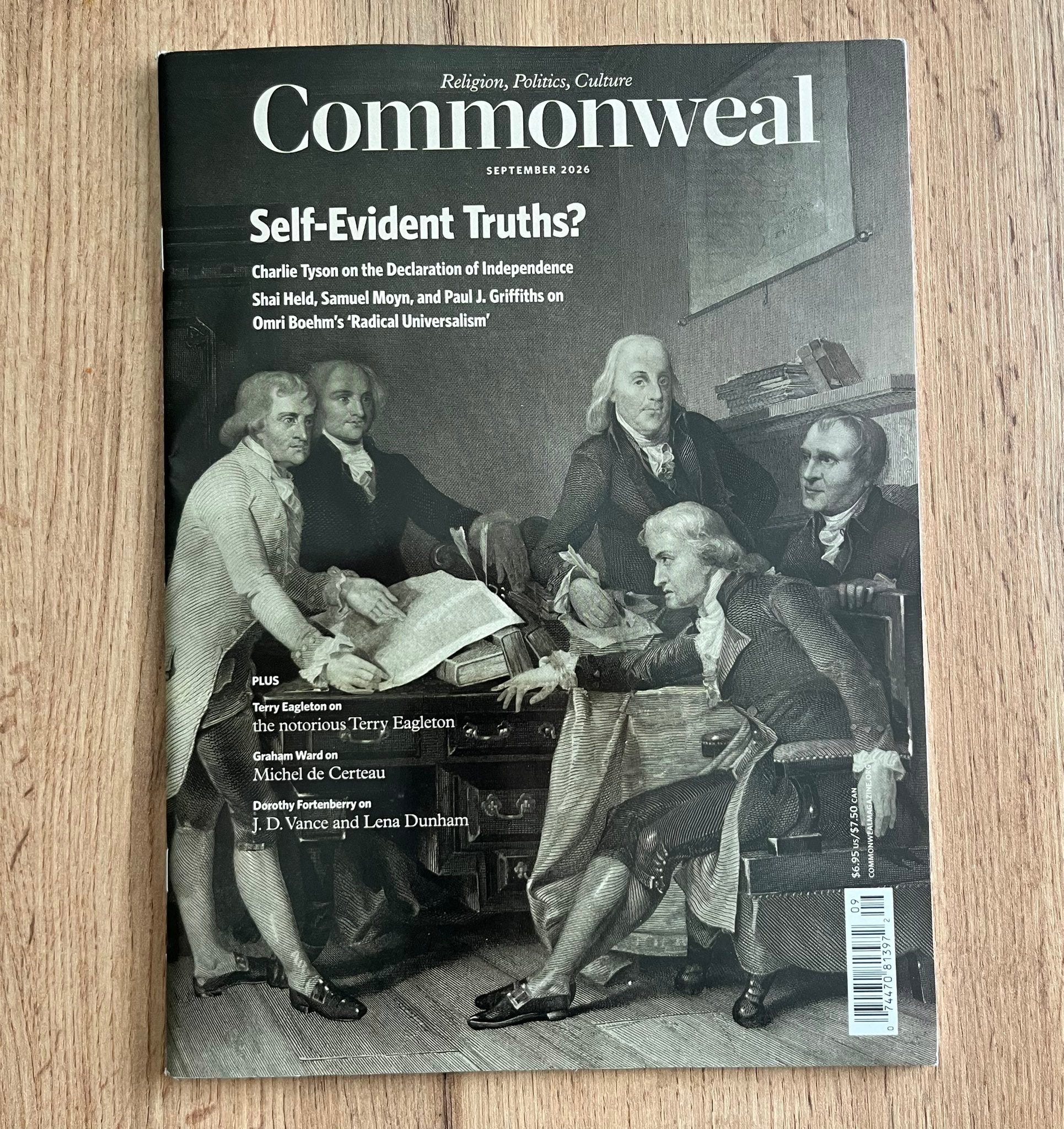
Second, I reviewed Mike Pence’s new book for Commonweal. Basically, I think Pence is delusional in attempting to launch a reconquista of the GOP from Donald Trump’s influence, not least because Pence played a pivotal role in helping Trump conquer it. One of the things that jumped out to me was that Pence portrayed Joe Biden’s policies as posing a graver threat to political order than the aborted auto-coup on January 6—a day on which he himself came dangerously “close” to being killed by Trump supporters, according to one former Situation Room officer. Pence is in deep denial about the state of conservatism or terminally partisan or both. You can read the full review online or in print.
Third, I wrote for The Nation about the right’s obsession with race and racial conflict, which I believe is something like its organizing principle. So much of the right’s objectives, rhetoric, and symbols flow directly from seeing itself as locked in a battle that will determine not just the demographic and cultural character of the country, but whether America will devolve into a system of overt racial totalitarianism. It is through this delusional framing that the right justifies everything from abuses of power to unprecedented corruption and even the deaths of political opponents, as seen with the killings of Renée Good and Alex Pretti in Minnesota. I think it’s funny how the right simultaneously embraces white supremacist views and messaging while also occasionally denying that it is doing exactly that. See, for example, “Auron MacIntyre” explicitly arguing that Texas students of Indian heritage, raised in the Dallas suburbs, don’t belong in Texas because they are not white.
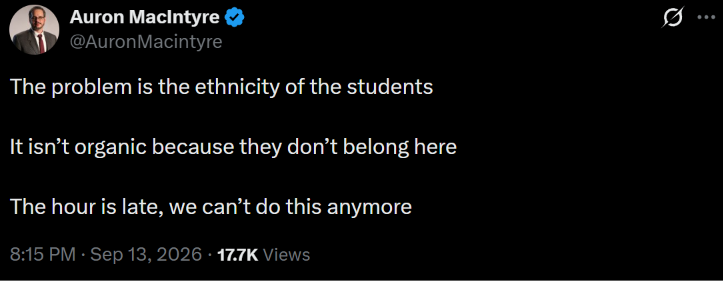
This uniquely repulsive creature is not a fringe figure. He is employed by The Blaze, regularly attends conservative conferences as a speaker, and is considered an important fixture in what passes for the right-wing intelligentsia—an oxymoron, to be sure. And so, it is not an exaggeration to say that it is a mainstream view on the right—increasingly the mainstream view—that to be American, truly American, one must be white.
Fourth, I’ve got a piece in The Spectator about the deportation of Milo Yiannopoulos.
Like most people on this planet, I dislike Milo, and so it was no surprise to see so many celebrate when he fell victim to the proverbial face-eating leopard that stalks just at the edge of the political jungle, waiting for the next right-winger to be cast out of the village and sent marching into hunting grounds.
I should know.
And as Milo was being subjected to what was essentially an international humiliation ritual orchestrated by his enemies in MAGA, the only people who came to his defense were libertarians and left-leaning pundits. No friends of Milo, these people issued principled defenses of someone they saw as a victim of a heavy-handed regime that is not above bringing to bear the awesome power of the state down on the heads of critics. It was humbling to watch, as someone who criticized that same crowd in the past.
The right, which conceives of itself as the true and only defender of civilization, descends into the reeking depths of barbarism the moment it obtains a modicum of power; it is willing to dynamite the pillars of order, so long as the roof of the thing kills its enemies too when it comes crashing down on everyone’s head. The opposition, in contrast, clustered opposite MAGA along the political spectrum, has a better understanding of just how fragile that order is, and why destroying it would be an act of civilizational suicide. That is why even Milo, yes, even he must be defended when the tyranny he had pined for finally comes knocking with a big grin.
That brings me to the first two podcasts I’ve done in a while.
In February, I appeared on Know Your Enemy, co-hosted by Matthew Sitman and Sam Adler-Bell. There, I took a real deep dive into my background and how I transitioned from being on the right to landing where I am now. After that, I joined Tim Miller of The Bulwark for a similar discussion.

These podcasts were very personal.
Tim, near the end of our talk, read some of the nasty things I had said to him in the past, back when I was a raging asshole on the right. He brought them up in good cheer, partly as a “look how far you have come” moment. I still apologized because I felt sincerely awful about it, and he was kind in turn. Likewise, Sam and Matthew were wonderful, kind hosts who held my feet to the fire while still extending a lot of grace my way. I really can’t say enough nice things about those guys, which, in a way, adds some healthy shame to this retrospective process. A lot of shame can sink you, turn into something poisonous. A healthy amount can help fasten hard lessons to the heart so they are not soon forgotten.
The other thing, a big thing for me, has been the heartening feedback from these shows and articles. That ties into the last part of this newsletter.
There aren’t many people who made the transition I did from MAGA to essentially a moderate and then stuck around to criticize the right. For a while, I didn’t really know who I was writing for anymore. I felt like I was on an island. It was dispiriting, to say the least. That seems to be changing now, in no small part because I suspect others feel the same way or maybe want to understand those who have been there. After both podcasts went live, I received very personal messages from readers who shared their experiences as disillusioned right-wingers. Men and women who are, as a consequence of the last decade of tumult, in various stages of rebuilding their lives and reevaluating their views.
As bad as things seem now, this has given me much cause for cautious optimism. One of the hardest things someone can do today is admit error, and it’s even harder to apologize for that error. To the extent that I can, I want to help, and I’ll be writing more frequently here to that end.
So, to new and old subscribers, the ones who have been with me for this long ordeal from the start, thank you for reading Contra.
pedro- i think it is time you read boethius- the consolation of philosophy- you are starting to take yourself too seriously
Disappointed to see you lump everyone on the Right into the same category. It may play to the Left, but you should know better.