


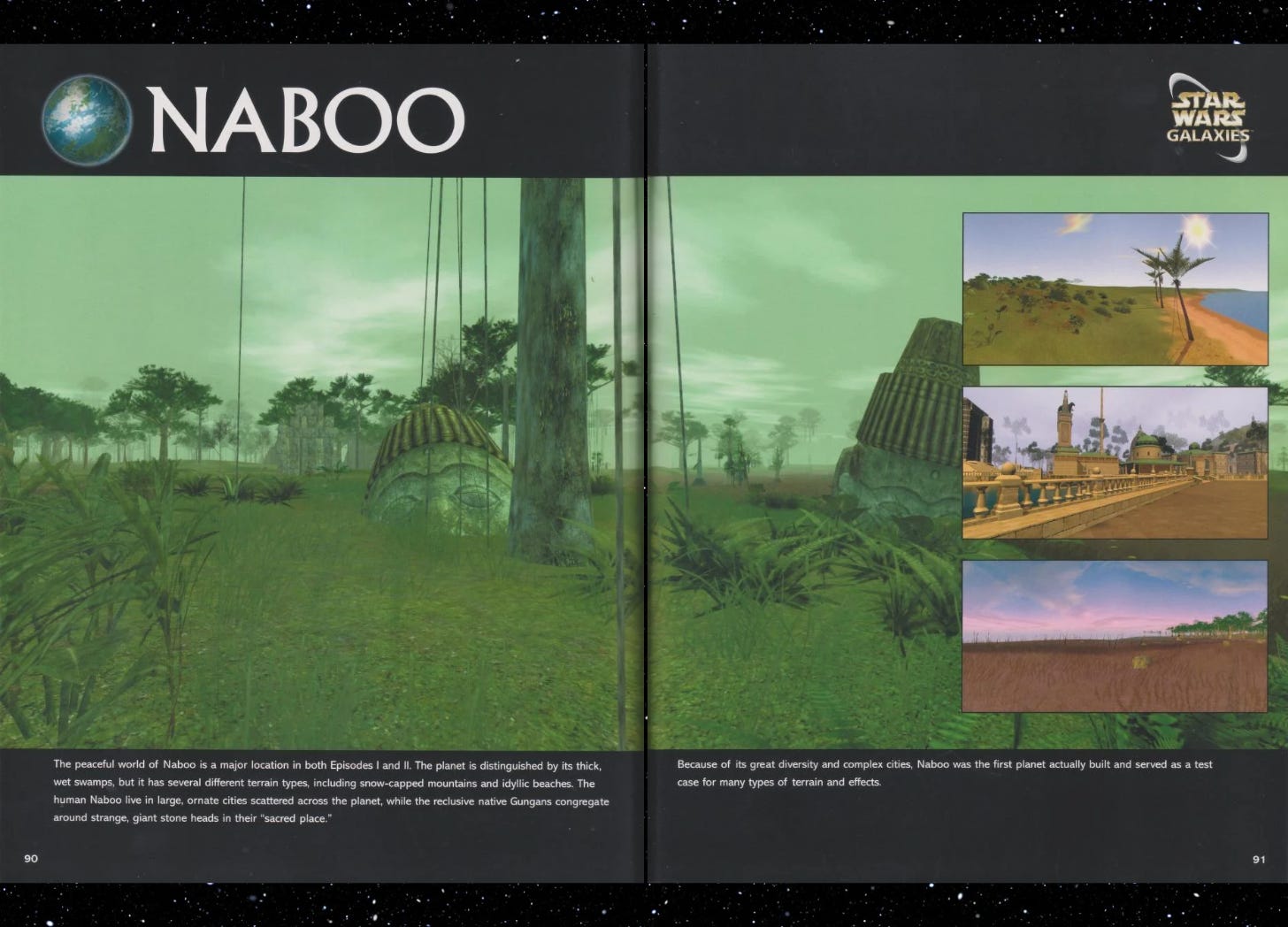
I didn’t have a great PC as a kid. Trying to play Star Wars Galaxies seemed at times like watching a jittery slideshow. But I couldn’t put it down because I knew it was something special.
Nothing before or since has combined a player-driven economy in which many or most items are crafted using schematics and resources that vary in quality, bioengineered pets from creature DNA, space combat and asteroid mining aboard multicrew ships with interactive interiors, player housing and democratically governed player cities (complete with in-game Ballot Box Terminals) set in a persistent sandbox of a universe filled with sprawling planets, and non-combat roles like entertainer that allowed and indeed encouraged people to interact with the game on a primarily social level around cantinas, starports, and guild halls. When the game launched in 2003, players weren’t able to select Jedi as a profession because Galaxies treated them the same way George Lucas did between A New Hope and The Empire Strikes Back: a hunted, incredibly powerful, and virtually extinct class of warrior-mystics.
Becoming a Jedi required months of grinding—mastering and discarding a random selection of different professions. Later, Holocrons were added to provide players with cryptic clues. One too many deaths before reaching Jedi Master status meant permanent character death. And if you managed to complete the grind, you had to be mindful to not reveal yourself as a Jedi in-game. Equipping a lightsaber or using your Force powers around other players exposed you to being targeted by player bounty hunters.
The progression system was later revamped around grinding and exploration that took you from non-Force sensitive to Force-sensitive. Again it demanded weeks or months of grinding across worlds to meet deliberately mysterious requirements. The /checkForceStatus command was the only way to see if you had made any progress. It returned one of six possible hot-or-cold responses:
“You feel no connection with the force.”
“You barely notice something different about yourself.”
“You feel a faint sense of the force.”
“You feel the Force surge within you.”
“You have a strong sense of the Force within you.”
“You feel an inner glow. The Force is with you.”


Reaching the “inner glow” phase would trigger a visit from the Old Man, an NPC who spawned at random in the wild. Even then, you were just getting started on the Jedi trials—an even longer and more complex progression system. It took months and months of work to go from Initiate to Padawan to Knight, and only full Knights could set foot inside the halls of either the Light or Dark Jedi Enclave on Yavin IV. Non-Jedi Knight players who tried to enter would be stopped by massively overpowered Sentinel NPCs. The interior of the facility was part legislature, part dueling chamber. Your rank determined where you physically sat inside and which rooms you could access within the Enclave.
The early Jedi mechanics in Galaxies represent one of the most overly complicated and unviable progression systems ever implemented. But that’s what made it so immersive and now legendary.
The Jedi system was just one part of it though. Galaxies was special, truly special, because it set out to be a fundamentally social game in which players could pass the time doing nothing except standing around a cantina and talking, or setting up a camp in the wilderness to explore together. It was, in other words, a virtual third space—a place to visit and live another life, before returning to your own.
Sony pulled the plug on Galaxies in 2011. But players refused to let it die and kept Galaxies alive on their own. Its afterlife continues on private servers like SWG Legends and SWG Restoration. I have characters on both.


Galaxies was—and is—really special. It stoked the flames of imagination and made me see video games as more than mere entertainment. At their very best, these things are high art and testaments to herculean ambition to build other worlds.
I touched on some of these themes in my essay about GTA VI, and I hope to write about gaming more. If you’re an editor and happen to read this, my inbox is open.
The other piece I’ve got out this week is about midterms. Not exactly as fun as GTA VI, but it’s worth your time. I hope you’ll check out both and consider picking up a subscription. I’m running a sale through Dec. 1. Contra is entirely reader-supported, so every sub helps.


I remember having a trailer for Galaxies built into my CD of Empire at War! When I was a teenager the game had long since shut down and I didn’t know about the fan project, so I was always so upset I never got to play.